

The instinctual expression
Supporting your creative leadership.
It’s so interesting how each creative has their unique way of expressing themselves. It’s the type of expression that supports the connection we build, gets our POVs across (to ourselves and others), and helps us understand what we have to say about any given topic. It’s the type of expression that we instinctively go to before any other kind. It’s the type of expression that supports what we’re building and others mirror back, this is so you.
We feel good about it when we’re in it.
We feel good about it when we dedicate time to it.
We feel good about it because it enhances our lives.
We feel good about it when it’s the expression we lead our creative business through — whether it’s part of the process or what we offer clients
(I’m curious, what’s your unique way of expressing yourself? How has it become part of your creative leadership? Share it in the comments!)
I’ll share the type of expression that supports everything I do.

Never in my wildest dreams did I think writing was going to be the main part of my career, let alone when I was writing the most during my pre-teen to teen years. I didn’t even know what I wanted to be when I grew up, but some ideas were a ballerina, a teacher, a cashier!? A weird trifecta, but up until the pre-teen ages, I was obsessed with all three. I found ways to force my sisters and brother to play games with me that included them. My mom even had my sisters and me in dance (I did it from 7-18ish years old) so it was impossible not to think about a career in it, but it didn’t matter if I wasn’t clear about what I wanted to be when I grew up.
When I figured it out in college, I found that writing was the central focus. As sophomore year came around, it was a path I simply had to be on. As if I could fight with divine timing anyway. Writing, reading, and learning through depth, aka requirements for a BA Arts in English, was the journey. Through it, I discovered how useful writing would be.
Not as something I just did or am simply good at. Not as something I had to pursue because I needed it for marketing-related opportunities. Not as a skill to strengthen, because one day it might become useful, but because it’s the starting point of connecting to myself and then with others. It also helped that I always went back to it before choosing a career was a thing, so I already had a foundation for the ongoing relationship with it.
If you want to hear more about the connection to writing, listen to this podcast episode I was on last year.
Here’s how present writing was before it became the primary expression I work through:
Wanted to tell my parents something that felt difficult to speak about? Writing was there.
Couldn’t figure out what I was feeling about a situation? Writing was the outlet.
Needed to untangle the teenage angst when it got really loud? Writing was what I ran to.
Had some time to kill in my room before a long day ahead? Writing in my notebook was it.
Crying in my bed with my childhood best friend about a boy? Writing a note to each other is what we did.
You can see how impactful it’s been and how, for me, it helps everything make sense and easier to go through. After I graduated from college in 2012, I searched for it in everything I did — editorial work, PR positions, copywriter roles. I even had a copywriting business where I wrote website copy for brands. It no longer exists, but of course it existed.
And here I am, still going strong with this writing thing. Still going strong by making every content topic I publish begin with long-form writing, aka the essays you read here at The Cornerstone.
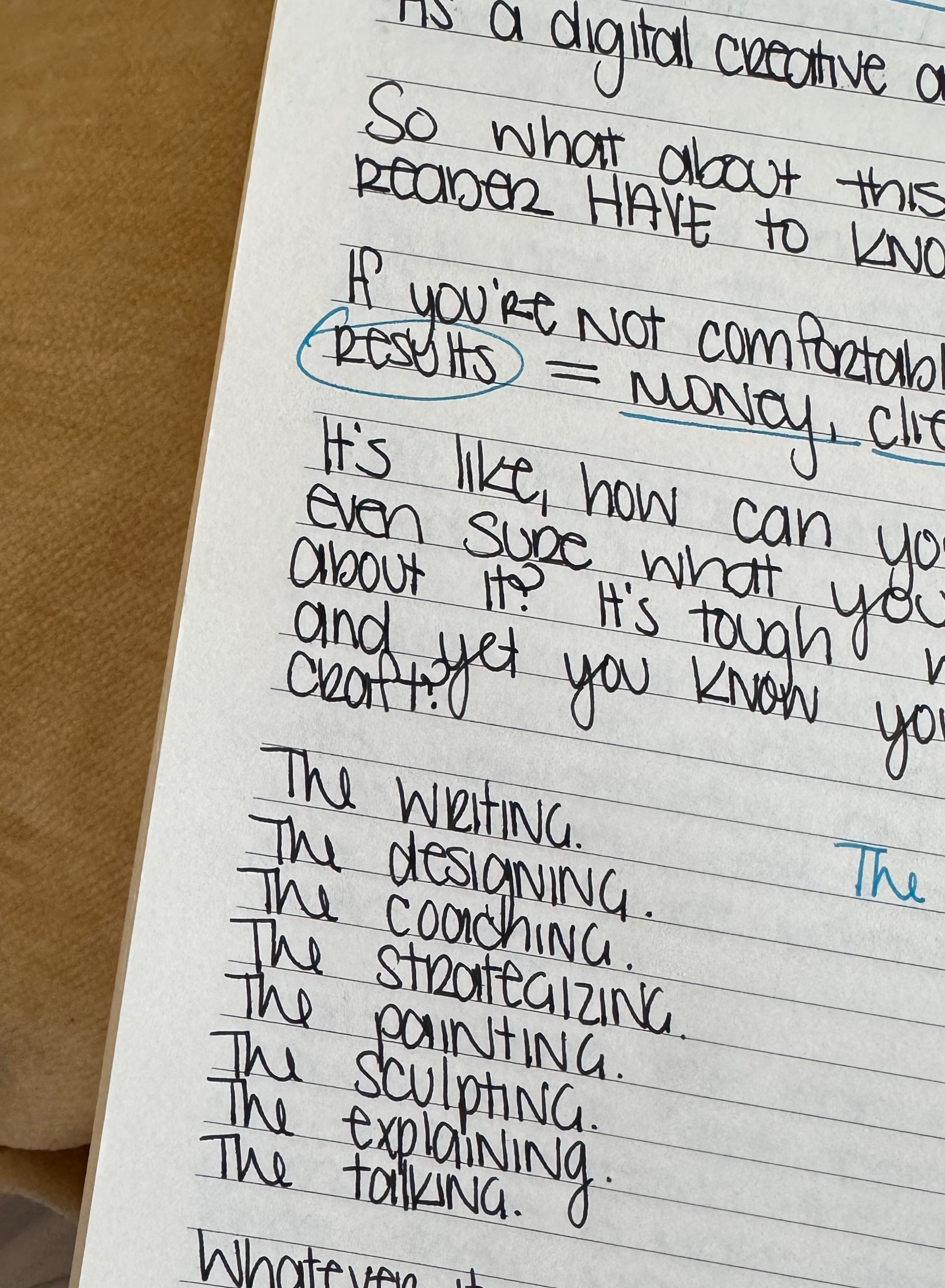
What it’s taught me, and a podcast I listened to recently helped me put words to it, is this: As a creative entrepreneur, you can’t rush the results you want if you don’t get comfortable with your type of expression. Your innate form of expression that becomes part of your creative leadership and is undoubtedly you for others to witness.
You simply can’t rush the pipeline from getting uncomfortable to getting comfortable. It’s not how entrepreneurship works. Personal patterns we would rather ignore inevitably show up, sometimes at the worst moments, but always in one that can teach you a different way of doing things.
In truth…
You’re building a business that isn’t about you getting lost in the sauce. You the human behind the brand. You the human who has a full life outside of it. You the human who’s shaping everything to the lifestyle you want. You don’t want to knuckle your way through each phase just to make it and feel lifeless in the process.
And if you find yourself rushing the process of getting comfortable, especially with the part of your creative leadership that holds the way of expressing yourself best, it’s like running a marathon you never trained for but expecting to run it well. In business, just like training for a marathon, you’re going to need to put in reps before it gets comfortable. You’re going to need to put in reps before the alignment you’re looking for arrives and stays.
Not enough people share that part when talking about alignment, and I so wish that would change.
Even with writing for me, it hasn’t been a journey I would call easy. It’s been a lot of trial and error to understand how it’s included in my business or where it fits into my entire ecosystem. I just always know it needs to be part of it. I’ve had to continue writing even when it felt clunky to figure it out. Focusing more on the goal than the tension of going from one season to another.
There are just some things that require different actions to stay with. Eventually, it all makes sense, even if it’s not always easy to stick to or trust in the beginning.
My trial and error moments have shaped so much of my life story (I’m also a Generator with a 3/6 profile in Human Design), so I know what it takes to get somewhere by not getting it quite right, all the time! Even when I can see what I want so clearly, if I’m not getting it yet, it’s because something hasn’t fully integrated. There are still reps of something to put in. Whether that’s resting, taking more action, removing things from my plate, having more fun, or all of the above.
That’s why how I support fellow creative entrepreneurs isn’t by bypassing any of this. I always want to consider what clients are going through in life and business, to create a strategy with depth. A strategy that considers the person who needs to make it happen first, before setting out the plan. That’s the foundation on which Anchor Session was built on and why I love this intimate call so much.
And why I’ll continue to find ways to support in this way as much as possible, no matter the version it turns into.
I hope that your unique way of expressing yourself is nurtured. That you don’t ignore it. That even if it’s not included in an offer, or what you support your clients with, it’s something that’s undoubtedly included in your business’s ecosystem. That expression, craft, creativity, skill, and whatever other words can be used to define it, is the reason you can build connections, get your POVs across, and understand what you even have to say about any given topic. It’s the type of expression that you instinctively go to before any other kind and truly supports what you’re building.
To leave you with some questions to mull over is so me, so that’s how I want to close this essay today. These questions are about the expression that supports your leadership — the innate one that’s so you. Dive right in:
How can I create without pressure?
How can I get comfortable with what I’m eventually going to share?
How can I understand how a POV lands for me first? And then, how is it going to be translated for my people?


If you’re ready to stop drifting to reach a goal and let your instinctual expression lead the way, Anchor Session is here for you. A 75-minute intimate call that focuses on what’s currently going on (in life and business) to identify the areas you’ll focus on to reach it.
Find out how to snag a spot, here.


I’m Ylani Estwick, a fellow visionary who supports creatives step into their leadership and voice. In my world, we understand what’s underneath the strategy before creating it, because your experience is what informs it best. If you find yourself subscribed to The Cornerstone, thank you so much for your support!
If ya fancy, send this essay to a friend ↓
If you’re new here and want to join the table, I would love to have ya ↓